
'If the dimensions of the strategic partnership worked out by India and the US seem like a grand alliance targeted at you-know-who, China had better realise that it has fathered it,' says B S Raghavan, a long time observer of China.

The question really is whether the US can be persuaded to embark on a path of calibrated and stronger sanctions on Pakistan.
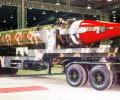
For the world and India, one of the most enduring challenges of the times is for Pakistan's nukes to be neutralised, before they are ever used by the State, their sponsored non-State actors or any rogue elements from the many terror tanzeems dotting Pakistan's unstable landscape, says Lieutenant General Kamal Davar (retd).

Theoretically, there is an inverse relationship, but other factors need to fall in place for it to work well this time

'Clearly, from the Indian viewpoint, the US retrenchment from Asia cannot be happening as good news.' 'The abandonment of the US' pivot to Asia exposes the US-Indian partnership to be a mere transactional relationship,' says Ambassador M K Bhadrakumar

The visit of Park Geun-Hye to India, though a symbolic one, will certainly give a further impetus to the strategic partnership between the two countries says Rup Narayan Das.

PM Modi seems to be gradually ending India's strategic ambiguity

It seems China is ready to cooperate with India in the central Asian region through the SCO framework, the reasons for which are manifold, says Sana Hashmi.
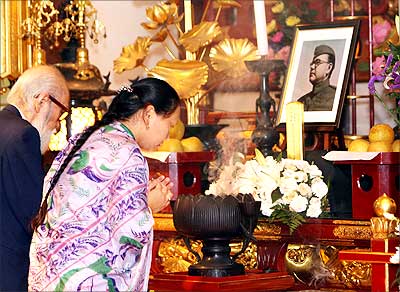
'The extended Bose family is insisting that the Japanese government must release all the information they have on Bose's ashes. It cannot be forgotten that Bose was in Japanese care when his 'death' occurred. Ultimately, it is the Japanese who hold the secret about what happened to him.'

While RBI is yet to come out with a clear regulatory framework for bitcoins, which have been gaining currency across the world over the past few months, it has issued an advisory cautioning general public against use of bitcoins and other virtual currencies.

'The ISI has given a stunning display of its capacity to do with impunity what it likes within Kabul. Incensed over the triumphalism of the hardliners in Kabul, the ISI has hit out; it is a typical ISI reflex action that Indians are familiar with,' says Ambassador M K Bhadrakumar.

'Whether it's investments in Kashmir, building naval facilities, or selling top-of-the-range military equipment, Pakistan could well benefit more under Xi's watch.' 'Do Chinese concerns about the 'Islamisation' of Pakistan give it pause about how quickly to move forward with security and economic projects? At the moment the indication is quite the opposite: China is doubling down on its support to Pakistan, partly because of its fears about where the country is headed.'

Despite the rally, on the basis of valuations, Indian markets aren't too expensive, says Christopher Wood, managing director and equity strategist at CLSA.

The government must justify why we need to buy foreign reactors when we have developed up to 700 MWe unit-size pressurised heavy water reactors, a design which can be easily extended to 900 to 1000 MWe unit size. Why can't the 'Make in India' philosophy apply to indigenous nuclear reactors, more than 18 of which have been designed, built, and being operated by Indian engineers, asks Dr A Gopalakrishnan.

'India is no longer the India of the '70s and the '80s.' 'It's a large country with the fastest growing economy.' 'In working with India, you just can't go and humiliate the nation publicly.' USIBC President Mukesh Aghi tells Aziz Haniffa/Rediff.com about how he advises American companies to do business with India, what he thinks of Modi's government and the way forward for the India-US relationship.
The second and final part of former cabinet secretary Naresh Chandra's interview to Sheela Bhatt.
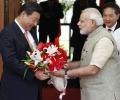
Arvind Subramanian talks about US and China's power play and where India figures in these dynamics.
